

ESOP taxation in India: the two tax points, explained
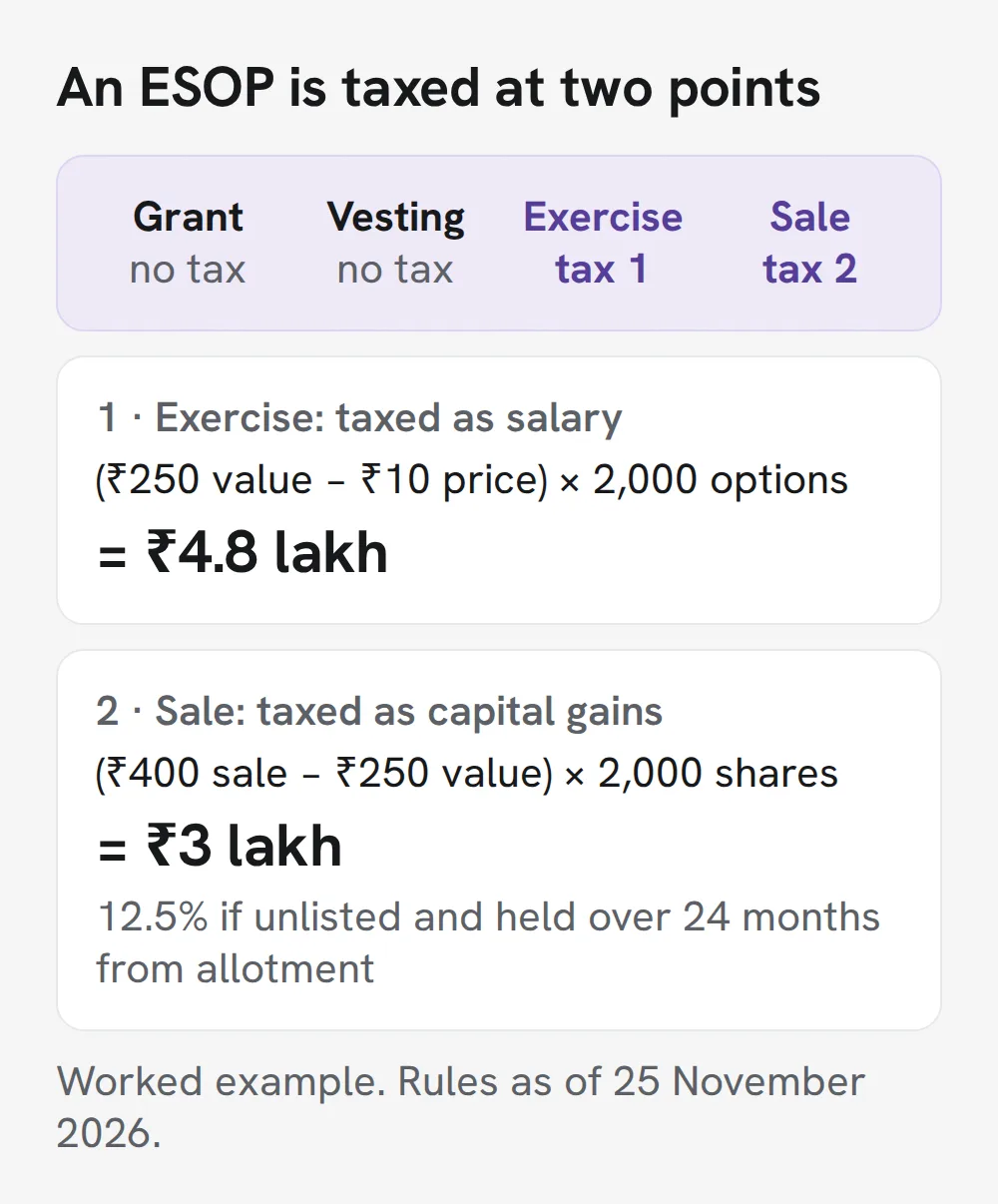
As of 25 November 2026, ESOPs in India are taxed at two points. When your employee exercises, the gap between fair market value and the exercise price is taxed as salary. When they later sell, the gain over that fair market value is a capital gain. Grant and vesting aren't taxed, and eligible startups can defer the first tax.
By Akshay Kendurkar, CEO, MyStartupValley

Your team will ask you how their ESOPs are taxed. Usually right after they exercise. If you can answer with an example in rupees, you'll save them a nasty surprise and save yourself a hard conversation. Here's the rule as of 25 November 2026, and where it's still moving.
How are ESOPs taxed in India?
ESOPs are taxed at two points: when your employee exercises, and when they sell. A perquisite is a benefit from an employer that's taxed as salary. Exercise is the moment your employee pays the exercise price and gets shares. Fair market value is the price set for that day, usually by a valuer. At exercise, the fair market value of your shares on the exercise date, minus what your employee pays you, is their perquisite, according to King Stubb & Kasiva's August 2026 note and TaxGuru's June 2026 summary.
| Moment | Taxed? | How |
|---|---|---|
| Grant of options | No | Nothing to pay |
| Vesting | No | Nothing to pay |
| Exercise | Yes | Fair market value minus exercise price, as salary, at the slab rate |
| Sale | Yes | Sale price minus the fair market value used at exercise, as capital gains |
You'll deduct tax at source on the perquisite, just as you do on their salary. That's your payroll's job, so you'll want it planned before your first exercise window opens. Don't leave it to March. Start early.
How do you work out the tax at exercise?
For example, take a case you can reuse. Your employee holds 2,000 vested options with an exercise price of ₹10. A merchant banker values your unlisted shares at ₹250 on the exercise date. The perquisite is ₹250 minus ₹10, times 2,000, which is ₹4.8 lakh, added to their salary for the year.
Your valuation's got rules too. For unlisted shares, a merchant banker usually sets the fair market value for the exercise date, as explained by TaxGuru and CAclubindia's note on the Income-tax Act, 2025. Keep that report. Don't lose it. You'll need it again when they sell. Keep a copy.
The tax arrives at exercise. The cash arrives at sale.
Can startup employees defer the ESOP tax?
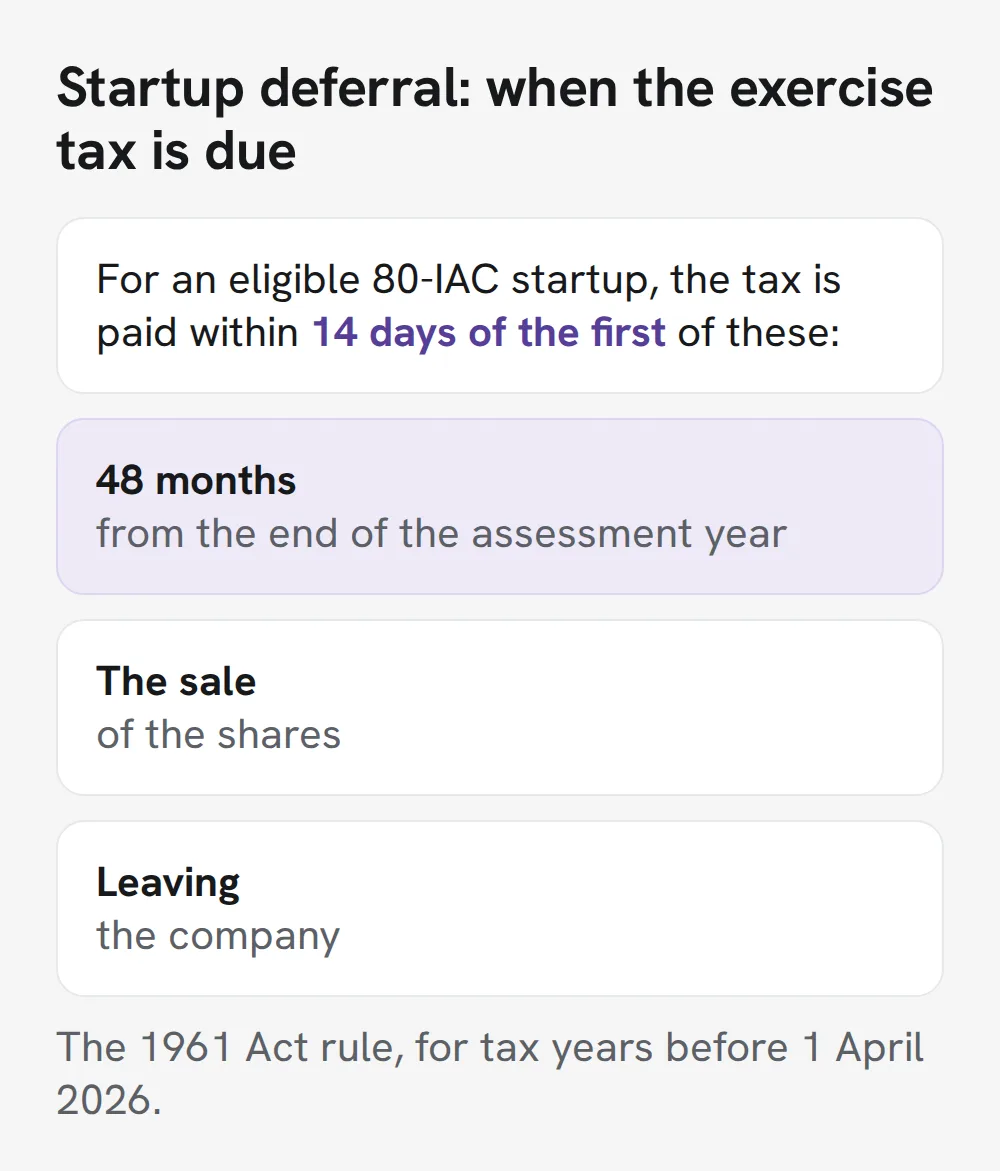
Yes, if your company is an eligible startup under the 80-IAC scheme. DPIIT recognition alone isn't enough, King Stubb & Kasiva warn; your company has to meet the scheme's own conditions. Check them first. Then your employee's tax on the perquisite isn't due at exercise. Under the 1961 Act rule, it's paid within 14 days of whichever comes first: 48 months from the end of the relevant assessment year, the sale of the shares, or the employee leaving, according to the government's memorandum to the Finance Bill, 2020, King Stubb & Kasiva and Patron Accounting.
It's a delay, not a discount. The amount's the same; only the date moves. For your team, that's the difference between paying tax on paper gains today and paying it when they can actually sell.
One point has moved. The Income-tax Act, 2025 governs tax years from 1 April 2026: the government's Budget 2026 memorandum amends it with effect from that date, for tax year 2026-27, and Angel One's July 2026 summary says the same. The deferral itself carries on: Startup India's April 2026 benefits playbook lists it next to the startup tax holiday under the new Act. For shares allotted from that date, check the deferral window with your chartered accountant before you tell your team a date.
What happens when the shares are sold?
When your employee sells, the fair market value used at exercise becomes their cost for capital gains, and the holding period runs from the allotment date, not the exercise date, according to TaxGuru and CAclubindia. Unlisted shares held more than 24 months are long-term, and long-term gains on them are taxed at 12.5% without indexation, according to the government's memorandum to the Finance (No. 2) Bill, 2024, Groww's August 2026 guide, and Business Today's Budget 2024 report. Shorter holdings are taxed at your employee's slab rate. Plan for that. That's why you'll want them to know their allotment date. Write it down.
Months before shares count as long-term
Back to your example. If your employee sells those 2,000 shares at ₹400 more than 24 months after allotment, the gain is ₹400 minus ₹250, times 2,000, which is ₹3 lakh of long-term capital gain. They've now been taxed twice, and you'll want them to know that early, on ₹4.8 lakh as salary and on ₹3 lakh as capital gains, but never on the same rupee.
For example, the sale is often a company buyback or a secondary. Our guide to secondary sales in Indian startups explains how those work and who buys.
What should you tell your team?
We analyzed the 2026 summaries cited here against the 2020 Budget memorandum to build this list. Put these points in a one-page note for your team before your first exercise window:
- Your grant and vesting aren't taxed; your exercise and sale are.
- Which valuation report sets the fair market value, and its date.
- Whether your company meets the 80-IAC conditions for the deferral.
- That the holding period starts at allotment.
- How and when you might be able to sell.
If you're still setting up your plan, our guide to ESOP basics for founders covers pools, vesting and grants. Investors will look at it too, as our post on ESOP pool checks explains, and DPIIT recognition matters for more than tax, as set out in our guide to DPIIT benefits.
Editorial note: the sources here were checked on 25 and 26 November 2026, and the deferral rule against the government's own 2020 memorandum.
The bottom line: two tax points, one possible deferral, and one open question on the 2025 Act window. It's an explainer, not tax advice; ask your chartered accountant to check your plan and your employees' facts.
Questions
When are ESOPs taxed in India?
At two points. On exercise, the fair market value on the exercise date minus what your employee pays is taxed as salary. On sale, the gain over that fair market value is taxed as capital gains. Granting and vesting options doesn't create tax by itself.
How is the fair market value of unlisted ESOP shares set?
A merchant banker usually values unlisted shares for the exercise date, as TaxGuru's June 2026 summary and CAclubindia's note on the Income-tax Act, 2025 explain.
Can startup employees defer ESOP tax?
Yes, if your company is an eligible startup. Under the 1961 Act rule, the tax is paid within 14 days of whichever comes first of 48 months from the end of the relevant assessment year, the sale of the shares, or leaving the company. For allotments from 1 April 2026, when the Income-tax Act, 2025 took over, check the window with your chartered accountant.
How are ESOP shares taxed when sold?
The fair market value used at exercise is your employee's cost, and the holding period runs from allotment. Unlisted shares held over 24 months are long-term and taxed at 12.5% without indexation; shorter holdings are taxed at slab rates.
Sources: Ministry of Finance, Memorandum Explaining the Provisions in the Finance Bill, 2020 (clause 47, ESOP tax deferral for start-ups), Feb 2020. · Ministry of Finance, Memorandum Explaining the Provisions in the Finance (No. 2) Bill, 2024, Jul 2024. · King Stubb & Kasiva, ESOP taxation in India: two-stage taxation and startup tax deferral, 22 Aug 2026. · TaxGuru, Taxation of Employee Stock Option Plan (ESOP), 9 Jun 2026. · CAclubindia, ESOP taxation under Income Tax Act 2025 (accessed 25 Nov 2026). · Patron Accounting, ESOP tax deferral for startup employees (accessed 25 Nov 2026). · Groww, Taxation of unlisted shares in India, 4 Aug 2026. · Business Today, Union Budget 2024: major changes in capital gains tax regime, 23 Jul 2024. · Ministry of Finance, Memorandum Explaining the Provisions in the Finance Bill, 2026 (accessed 26 Nov 2026). · Angel One, Income-tax Act 2025 transition rules clarified by CBDT, 13 Jul 2026.
Before your first exercise window, you'll want your valuation report, cap table and option records in one folder that investors can check.
MyStartupValley Founders is the dedicated system for Indian founders raising pre-seed to Series A. The MSV team evaluates each startup on six due diligence parameters, so founders know what to fix before they pitch. Founders keep their profile, monthly traction and data room current, and reach investors whose sector and stage fit.
You decide when to raise and which investors to pitch. See how it works on MyStartupValley Founders.