

Founders' agreement in India: what it covers and why
A founders' agreement is a contract between co-founders that records who owns what, who does what, and what happens if someone leaves. In India it binds you as founders like any contract. Terms that need to bind your company too, such as share transfer limits and buybacks, also have to sit in your articles of association.
By Akshay Kendurkar, CEO, MyStartupValley

You and your co-founder agree on everything now. That's exactly when you should write it down. Do it today. A breakup with nothing on paper can freeze your cap table, your IP and your next round. Here's what your founders' agreement should cover in India, and where it needs backup from your company's own documents, which is the part many teams miss.
What is a founders' agreement, and do you need one in India?
A founders' agreement is a contract between you and your co-founders that records each person's shares, role, time and exit terms. No law says you've got to sign one. Investors will still ask, and if you can't show them one, they'll usually ask you to sign one before the money arrives, which is a worse time to negotiate with your co-founder. And Startup India's legal and regulatory checklist lists a founders' agreement "detailing roles, equity split, and exit clauses" among the contracts a startup should have.
Startup India, the DPIIT programme, also publishes a sample founders' shareholders agreement, which covers share ownership, decisions that need the partners' consent, lock-in on transfers and a bad leaver buyback. You don't have to use it. Read it anyway. It shows you the ground your own agreement should cover. Use it as a map. It's a good start.
How should co-founders split equity?
There's no correct split, only one you can defend. Here's what the data says. In a widely cited study, Thomas Hellmann and Noam Wasserman looked at 1,476 founders in 511 ventures. Roughly one third of teams split their equity equally, according to NBER Working Paper 16922 and the NBER Digest summary of August 2011.
They also found that equal splits were linked to lower pre-money valuations in your first financing round, which is the round you care about. That one stings. CBS News noted in May 2011 that this isn't necessarily caused by the split itself, while the authors' estimate of what a stronger founder gives up by accepting an equal split is below. You'll notice it isn't small.
What an equal split can cost the stronger founder
Keep in mind it's a US dataset, so you should read it as a direction, not an Indian benchmark. In practice, you and your co-founders will weigh a few things:
| Factor | Question to ask each other |
|---|---|
| Time | Which of you is full-time from day one, and who joins later? |
| Capital | Who's putting in money, as equity or as a loan to the company? |
| Role | Which of you owns product, sales or fundraising for the next two years? |
| Track record | Does anyone bring prior exits, an Indian or US patent, or key customers? |
| Idea and IP | What did each of you build before you set up the company, and is it assigned? |
Vesting is a rule that lets you earn your shares over time. Whatever split you pick, vesting's what keeps it fair over the years that follow, because it ties each founder's shares to the time they actually put in rather than to how the team felt on the day you incorporated. It protects everyone. A common pattern is vesting over several years, with a cliff before the first shares vest. Our guide to founder vesting in India explains cliffs and monthly vesting. Unvested shares usually pass to the other founders or the company under your articles.
What clauses does an Indian founders' agreement need?
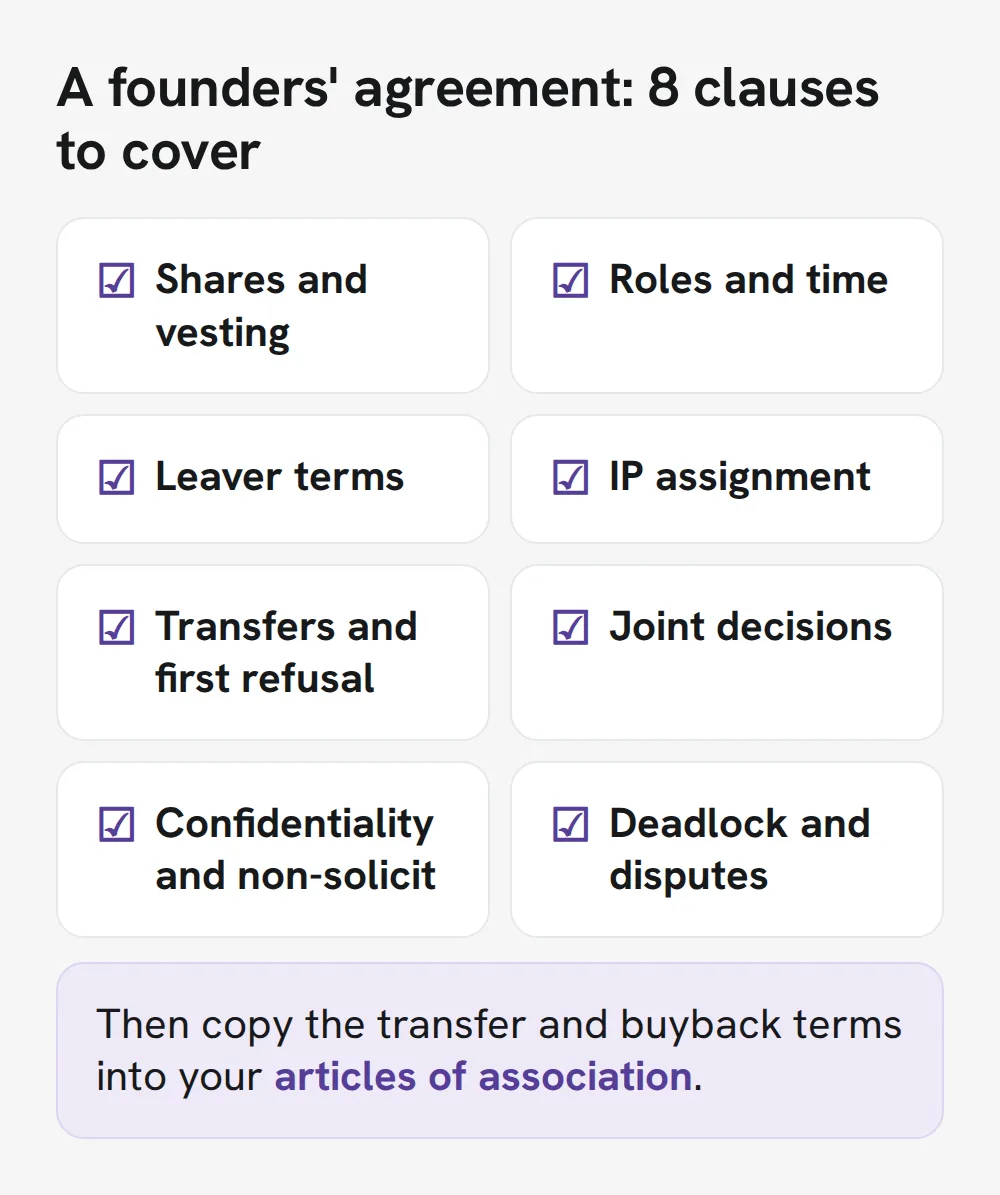
Your agreement should cover the same core ground as everyone else's, and we analyzed Startup India's sample, notes from 2 law firms, 2 Mondaq articles and a Bar and Bench analysis, published 2021 to 2026, to build this list. That's 8 items. You'll want all of them.
- Shares and vesting: your holding, your co-founder's, and the vesting schedule and cliff you'll each follow.
- Roles: your titles, duties and time commitment.
- Leaver terms: what happens to vested and unvested shares when someone leaves, and at what price the others can buy them back.
- IP assignment: the code in your GitHub repos, the designs in your Figma files and the brand you created, before and after incorporation, belong to your company, not to you, and so does any trademark you've filed with the Trade Marks Registry, or design you've registered with the Patent Office.
- Transfers: lock-ins, and first refusal for the rest of you, mirrored in your articles under Section 2(68).
- Decisions: what needs all of you to agree, such as issuing new shares or selling your business.
- Confidentiality and non-solicitation: what a departing founder can't take or do.
- Disputes: how you'll break a deadlock between you, for example through arbitration seated in a city such as Bengaluru, Mumbai, Hyderabad or Delhi that you both name in advance.
A bad leaver is a founder who leaves on terms the agreement treats as a breach, such as quitting early or being fired for cause. Leaver terms are where your agreement will need real thought, and Startup India's sample, for example, says your bad leaver's defined share of holdings transfers to the company at nominal value. Harsh, but you'll know where you stand. Khurana and Khurana's October 2026 note on Indian vesting clauses describes the same good leaver and bad leaver buyback structure. Your IP's worth its own document too, so see our guide to IP assignment for startups in India.
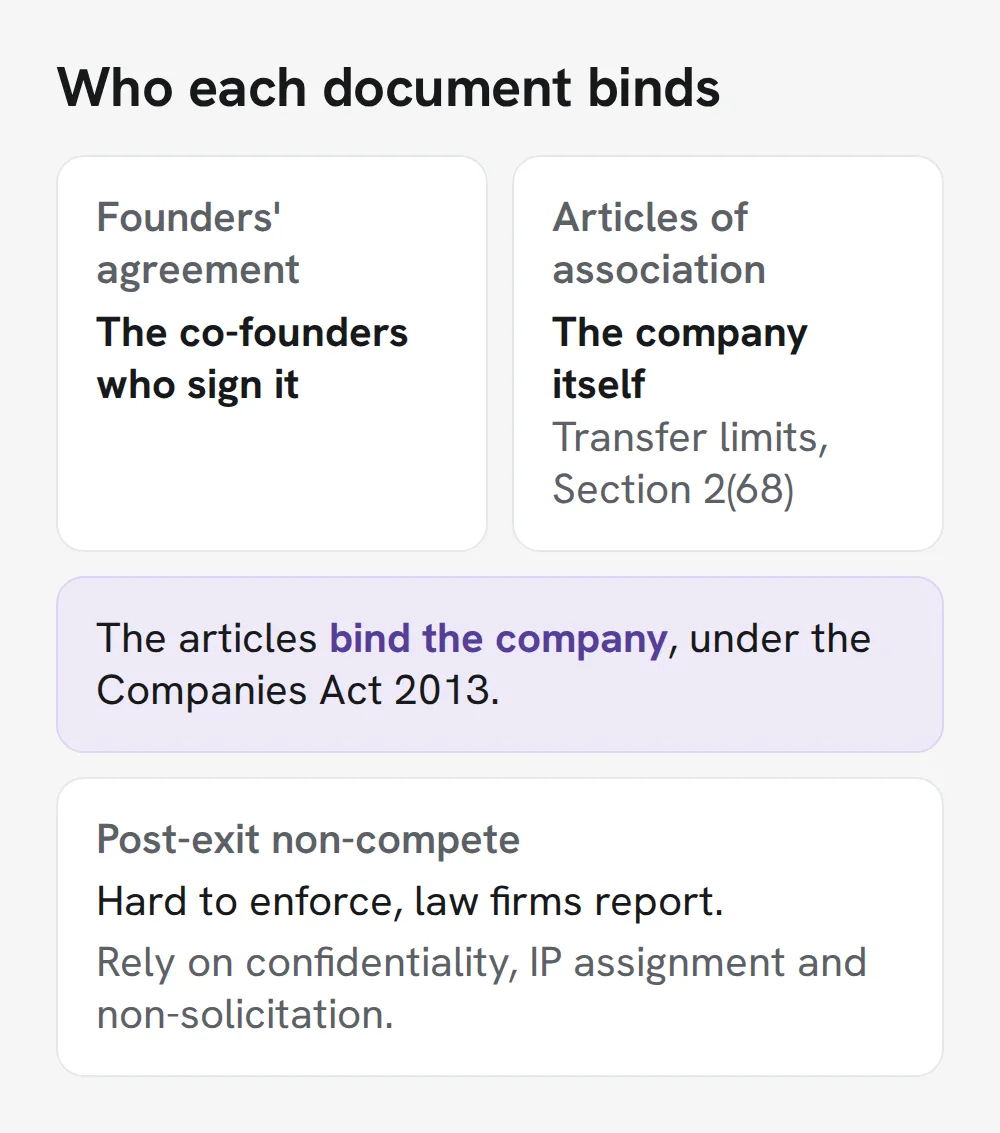
Your agreement binds your co-founders. Your articles bind your company.
Is a founders' agreement enforceable in India?
Yes, between you and the co-founders who sign it. It's a contract. The catch is your company, because a contract between shareholders doesn't automatically bind the company whose shares you're all holding. Under Section 2(68) of the Companies Act, 2013, a private company restricts the transfer of its shares through its articles, as Khurana and Khurana set out on 22 October 2026. If you want your company to enforce transfer limits and buyback rights, they belong in your articles too.
Your articles are what bind the company: the Companies Act, 2013 says the articles, once registered, bind the company and its members. Courts have treated a shareholders' agreement as binding among shareholders only where it isn't at odds with the articles, according to a Mondaq analysis of October 2021 and a Bar and Bench view of 29 January 2026. So once you've signed, amend your articles so they say the same. Then keep both in step.
Non-competes are the other trap you'll hit. Courts, including the Delhi High Court, have refused to enforce post-exit restraints without a real business interest to protect, as Nishith Desai Associates noted on 3 July 2025. So you'll usually lean on confidentiality, IP assignment and non-solicitation instead. They hold up better.
What will investors check in your founders' agreement?
At seed, whether it's an angel in Pune, a family office in Chennai or a fund in Bengaluru, your investor wants to know your team won't fall apart and leave the cap table in pieces. You'll get questions like these. Prepare your answers. Write them down.
- Is your vesting in place, and does it restart or carry on after the round?
- Have you all assigned your IP to the company?
- Do your articles carry the transfer and buyback terms under Section 2(68)?
- Are there side deals between you that they can't see?
Many of your terms move into your shareholders' agreement at your first priced round, often seed or Series A, and you should expect the SHA to add investor rights such as information rights, a board seat and anti-dilution. Our guide to shareholders' agreement clauses in India covers what changes, and the full document list investors ask for is in our startup due diligence checklist.
When should you sign it?
Before you issue shares. Ideally on day one, before your incorporation papers go to the Registrar of Companies through the Ministry of Corporate Affairs portal, because it's far easier to agree vesting and leaver terms while nobody owns anything yet. If you've already incorporated, it isn't too late, but every founder will have to agree to put vesting on shares already issued.
Editorial note: the sources here were checked on 25 and 26 November 2026, and the company-law points against the Companies Act text on India Code.
The bottom line? Write it while you still agree, check that your articles mirror it, and get a lawyer to review it. This post explains what agreements usually cover; it isn't legal advice for your company.
Questions
Is a founders' agreement mandatory in India?
No law requires one. It's a private contract between co-founders. Startup India's legal and regulatory checklist lists it, covering roles, equity split and exit clauses, and investors usually ask how these points are settled during diligence.
Is a founders' agreement legally binding in India?
Yes, between the founders who sign it, like any valid contract. It binds your company only where its terms also sit in the articles of association under the Companies Act, 2013. That Act makes your articles bind the company, and where the two conflict, courts have held that the articles prevail.
Should co-founders split equity equally?
There's no rule. In Hellmann and Wasserman's study of 1,476 founders in 511 ventures, about one third of teams split equally, and equal splits were linked to lower first-round valuations. Many teams weigh full-time commitment, capital, role and experience instead.
Can a founders' agreement stop a co-founder from competing after leaving?
Usually not for long. Law firms such as Nishith Desai Associates report that courts have refused to enforce post-exit non-competes without a real business interest to protect. Confidentiality, IP assignment and non-solicitation clauses are where founders usually focus.
Sources: Startup India, Legal and regulatory checklist for startups (accessed 25 Nov 2026). · Startup India, Founders' shareholders agreement sample (template PDF), accessed 25 Nov 2026. · Hellmann and Wasserman, The First Deal: The Division of Founder Equity in New Ventures, NBER Working Paper 16922, 2011. · NBER Digest, The Division of Founder Equity in New Ventures, Aug 2011. · CBS News, Why your co-founder shouldn't get half the company, 26 May 2011. · Khurana and Khurana, Founder vesting clauses in Indian startup shareholders' agreements, 22 Oct 2026. · Mondaq (India), Shareholder agreements: the articles conundrum, 1 Oct 2021. · Bar and Bench, The SHA-AoA intersection: decoding an evolving judicial approach, 29 Jan 2026. · Nishith Desai Associates, Delhi HC's strict scrutiny of post-employment restraints, 3 Jul 2025. · Mondaq (India), Founders' agreement: a primer, 21 May 2024. · Companies Act, 2013, sections 2(68) and 10 (India Code, accessed 26 Nov 2026).
Investors will ask for your founders' agreement, your IP assignments and articles that mirror them, so keep signed copies next to your cap table.
MyStartupValley Founders is the dedicated system for Indian founders raising pre-seed to Series A. The MSV team evaluates each startup on six due diligence parameters, so founders know what to fix before they pitch. Founders keep their profile, monthly traction and data room current, and reach investors whose sector and stage fit.
You decide when to raise and which investors to pitch. See how it works on MyStartupValley Founders.