

Pre-money vs post-money valuation, worked in rupees
Pre-money valuation is what your company is worth just before new money comes in. Post-money valuation is that figure plus the new investment. Your investor's stake is their cheque divided by the post-money figure, so ₹2 crore into a ₹8 crore pre-money buys 20%. Your term sheet should say which one it means.
By Akshay Kendurkar, CEO, MyStartupValley

Two numbers decide how much of your company you sell in a round, and they're easy to mix up. If you agree a valuation without checking which one it is, you can give away more than you planned. Here's the arithmetic in rupees, with the Indian details that change it. It's simpler than it looks.
What's the difference between pre-money and post-money valuation?
Pre-money valuation is the value you and your investor agree for your company just before the new money comes in. Post-money valuation is that value plus the new investment. Your investor's stake is their cheque divided by the post-money figure. That's the whole formula.
Those two definitions come from public references such as Wikipedia's entry on post-money valuation and Orrick's startup glossary. Wikipedia also notes there isn't an industry consensus on the precise definitions, so you shouldn't assume. Ask. Your term sheet has to say which one it means. Don't guess.
| What you want to know | How you work it out |
|---|---|
| Post-money valuation | Pre-money plus the new investment |
| Your investor's stake | New investment divided by post-money |
| Pre-money, if you only know the stake | Investment divided by the stake, minus the investment |
| Price per share | Pre-money divided by the fully diluted shares before the round |
How does it work in an Indian seed round?
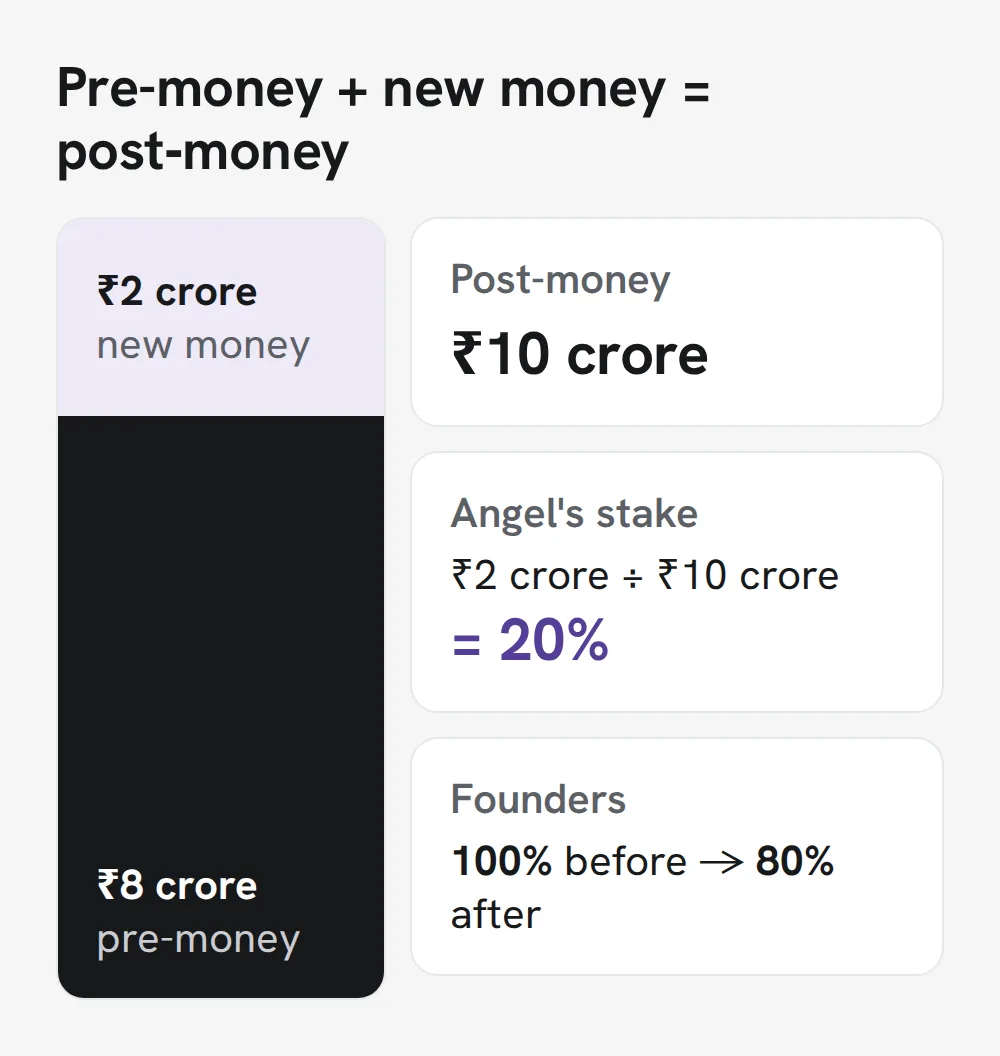
Let's take a simple case, using the standard post-money formula. You agree a pre-money valuation of ₹8 crore, and an angel invests ₹2 crore. Your post-money valuation is ₹10 crore, and the angel owns ₹2 crore divided by ₹10 crore, which is 20%. You and your co-founders keep 80%, if nothing else changes. That's your whole round in one line.
Now your share count, which Orrick's glossary ties to the post-money figure too. Say your company has 80,000 fully diluted shares before the round. Your price per share is ₹8 crore divided by 80,000, so ₹1,000. The angel's ₹2 crore buys 20,000 new shares at that price, and your company ends the round with 1 lakh shares (Orrick glossary). Check it: 80,000 plus 20,000.
For example, if your angel had asked for 20% at a ₹8 crore post-money instead, they'd pay you ₹1.6 crore for the same stake, and you'd have raised ₹40 lakh less, on Orrick's post-money formula. Same stake, less cash. That's why you'll want the word "pre" or "post" written next to every valuation figure you discuss.
Why does the ESOP pool change your real pre-money?
An option pool is a block of shares set aside for future employee stock options. Investors often ask you to create or add to one as part of the round, usually before their money comes in, as a June 2024 DealTerms note on Mondaq explains for Indian rounds. Where that pool sits decides who pays for it. Usually, you do. If it's created inside the pre-money, it dilutes only you and the other existing shareholders. If it's created after the round, your new investor is diluted too.
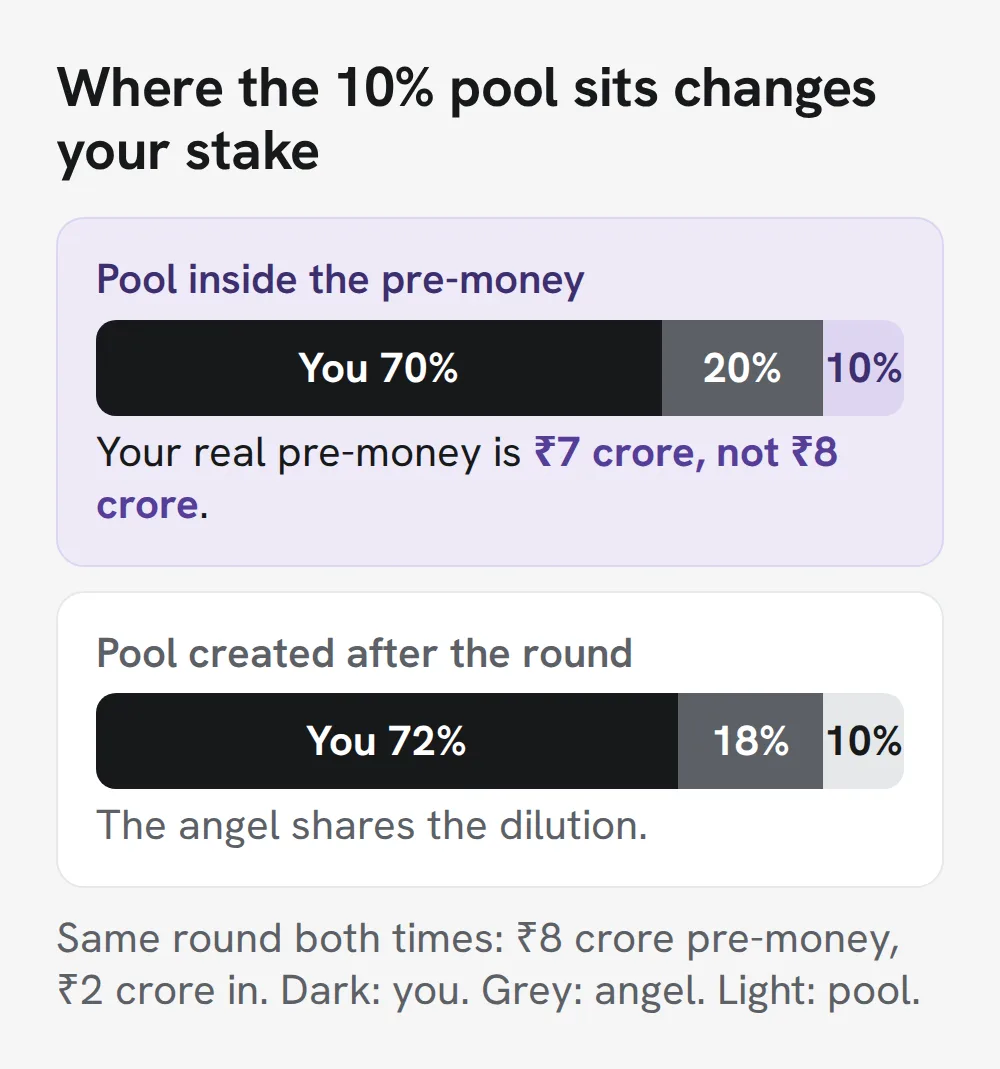
Keep the same round and add a pool equal to 10% of the post-money (worked with the formula above, Mondaq 2024). Here's how your share and the angel's share move:
| Where the pool sits | Your founders' stake | Angel's stake | Pool |
|---|---|---|---|
| Inside the pre-money | 70% | 20% | 10% |
| Created after the round | 72% | 18% | 10% |
That's the option pool shuffle, as a Long-Term Stock Exchange explainer and Holloway's venture capital guide call it. In the first row, your angel still gets 20% for ₹2 crore, but the pool's ₹1 crore of value came out of your side. Your effective pre-money is ₹7 crore, not ₹8 crore. Quietly. In the second row, everyone takes some of the dilution. You'd keep two more points. Our guide to ESOP basics for founders explains how pools are sized and granted.
Agree the share count and the pool before you agree the price.
What do CCPS, notes and iSAFE change in India?
Fully diluted shares are all the shares your company would have if every option, convertible and note turned into equity today; many Indian rounds use compulsorily convertible preference shares, which turn into equity shares later. Because they convert, they belong in a fully diluted count, so they affect your price per share. Count them. Our explainer on CCPS vs CCD covers how each instrument works.
Notes are next. Convertible notes and iSAFE notes from earlier angels usually convert at your next priced round, and whether their valuation cap is read as pre-money or post-money changes how many shares they take, and so how much you keep. If you've raised on notes, you'll want to model this first. Read our guide to iSAFE notes in India before you model the round.
Two Indian rules also touch your price, and you can't skip either. Under the RBI's Master Direction on Foreign Investment, shares your unlisted company issues to a foreign investor can't be priced below a certified fair value. And Section 62 of the Companies Act, 2013 links certain share issues to a registered valuer's report. A price above fair value also used to carry an angel tax risk, which the government's memorandum to the Finance Bill, 2023 extended to non-resident investors, until the 2024 Budget memorandum switched it off for new rounds. Our post on valuation methods for early-stage startups covers how that price is built.
How has seed pricing moved in 2025?
Seed money got scarcer in 2025. You'll feel it. According to Tracxn data reported by TechCrunch on 27 December 2025 and CXOToday on 18 December 2025, seed-stage funding into Indian tech startups fell 30% to $1.1 billion in 2025, while early-stage funding rose 7% to $3.9 billion.
Indian tech startup funding by stage, 2025
We analyzed both reports, dated 18 and 27 December 2025, and fact-checked each figure against the two pages before using it. Read together: when there's less seed money, each investor you meet has more choice, and you'll get more questions about how your price was set. If you've got a clear pre-money, post-money and share count table, you'll answer many of them before they're asked.
What should you check in your term sheet?
The bottom line: one headline number can hide two points of ownership in this example. Before you sign, make sure your term sheet answers each of these in writing. It's your checklist of questions, not legal or tax advice; your lawyer and chartered accountant should check the final documents.
- Is the valuation stated as pre-money or post-money?
- How big is the ESOP pool, and is it inside the pre-money?
- What's in the fully diluted share count: options, CCPS, notes, iSAFE?
- What's the price per share, and does it clear the FEMA floor if a foreign investor is in? (Below it, the issue breaks the rule.)
- Do earlier notes convert on a pre-money or post-money cap?
Editorial note: the market figures here were checked against two dated reports, and the worked example against the formula sources, on 25 and 26 November 2026.
Don't sign until you've seen your own cap table after the round. Once you know your post-money stake, our guide on how much equity to give angel investors helps you see what you're giving at each stage. It's your company; know your number.
Questions
Is the valuation in a term sheet pre-money or post-money?
It depends on the wording, and there isn't one industry standard. Read the clause: it should say pre-money or post-money, define the fully diluted share count, and say whether the ESOP pool sits inside it. If it doesn't, ask before you sign.
How do I calculate post-money valuation?
Add the new investment to the pre-money valuation. A ₹2 crore cheque into a ₹8 crore pre-money gives a ₹10 crore post-money. Your investor's stake is ₹2 crore divided by ₹10 crore, which is 20%.
Does the ESOP pool come out of the pre-money?
Often, yes, when investors ask for the pool to be created before the round. Then only the existing shareholders are diluted by it. If the pool is created after the round, the new investor is diluted too. The term sheet decides which.
Do CCPS count when you work out the price per share?
Usually, yes. Compulsorily convertible preference shares turn into equity shares, so a fully diluted count includes them, along with options and any notes or iSAFE that convert in the round. Check how your documents define the count.
Sources: Wikipedia, Post-money valuation (accessed 25 Nov 2026). · Orrick, Tech Studio glossary: Post-Money Valuation (accessed 25 Nov 2026). · TechCrunch, India startup funding hits $11B in 2025 as investors grow more selective (Tracxn data), 27 Dec 2025. · CXOToday, India's startup funding slows, but the ecosystem comes of age: Tracxn, 18 Dec 2025. · Reserve Bank of India, Master Direction: Foreign Investment in India (updated up to 15 Jun 2026). · Companies Act, 2013, section 62 (India Code). · Long-Term Stock Exchange, Funding your startup: the impact of the option pool shuffle (accessed 25 Nov 2026). · Holloway, Guide to Venture Capital: A Primer on Ownership (accessed 25 Nov 2026). · Mondaq (India), Startup Funding: DealTerms Demystified, Part I, Pre and Post Money Valuation, 20 Jun 2024.
Before a priced round, you'll want a current cap table, a fully diluted share count and your pool size on paper, so the price you agree is the price you meant.
MyStartupValley Founders is the dedicated system for Indian founders raising pre-seed to Series A. The MSV team evaluates each startup on six due diligence parameters, so founders know what to fix before they pitch. Founders keep their profile, monthly traction and data room current, and reach investors whose sector and stage fit.
You decide when to raise and which investors to pitch. See how it works on MyStartupValley Founders.